Chop, Blindfold, Repeat: 40 Home Cooks Can't Tell a $30 Knife From a $300 One
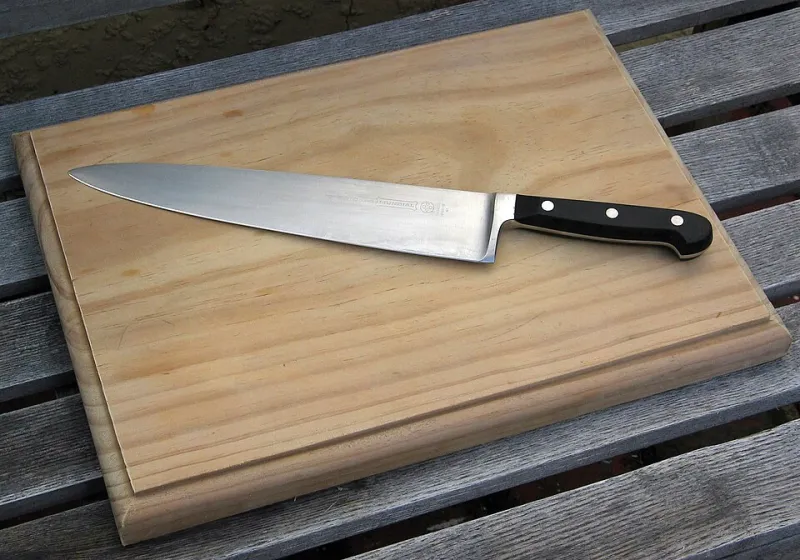
Photo: Donovan Govan., CC BY-SA 3.0, via Wikimedia Commons
There's a moment in every kitchen store where the price tags start to feel like a dare. $189. $275. One Japanese-made chef's knife near us is listed at $419, and the display stand looks like it should be behind glass.
We wanted to know if that money buys anything you can actually feel. So we ran the most unscientific-sounding test we could think of — and it turned out to be the most revealing comparison we've done all year.
The Setup: No Chefs Allowed
Here's the thing about knife reviews written by professional chefs: they're experts testing for experts. Their hands are trained, their technique is muscle memory, and their standards reflect a kitchen most of us will never work in.
But the vast majority of knife buyers are people making weeknight stir-fries and Sunday roasts. So that's who we recruited: 40 home cooks from around the country — college students, retirees, parents of three, a guy who admitted his current knife came free with a cutting board. Ages ranged from 22 to 71. Cooking skill ranged from "boils water confidently" to "hosts Thanksgiving."
Each participant received two 8-inch chef's knives with all branding removed: a budget model retailing around $30 and a premium German-made model retailing around $300. Both were freshly sharpened by the same professional sharpener to remove any factory-edge variability.
Round One: The Blind Chop Test
First, a controlled test. Each cook chopped the same four ingredients with both knives, unlabeled and in random order: ripe tomatoes, yellow onions, a bundle of parsley, and raw chicken breasts.
They scored each knife on sharpness, comfort, control, and overall preference — without knowing which was which.
The results were closer than the price gap. The premium knife won overall preference, but only 55% to 45%. On the tomato test — the classic sharpness tell — the two knives were statistically tied. Several participants actually scored the budget knife higher on comfort, noting its slightly heavier feel gave them more confidence.
One participant, a nurse from Arizona who cooks dinner most nights, said afterward: "I genuinely thought the cheap one was the expensive one. It went through the onion like butter."
Round Two: Three Months of Real Life
Then the harder test. Half the group kept the budget knife for eight weeks; half kept the premium one. They cooked normally — no special care, no honing rituals unless they already did them, no kid-proofing, no pampering.
At the end, we collected all 40 knives and had them re-tested on the tomato and onion by a neutral panel.
Both groups showed edge degradation, as expected. But the gap between them was smaller than the gap between careful users and careless users within each group. In other words: how you treat a knife predicted its performance better than what you paid for it. The participant whose premium knife performed worst? He'd been cutting bagels on a ceramic plate. The best-performing budget knife belonged to a retired teacher who honed hers on a $12 rod every Sunday.
So What Are You Paying For?
Here's where it gets interesting. After the test, we asked our sharpener — a guy who's handled thousands of blades — to break down the actual material difference between our two knives.
His take: the steel in a well-made $30 knife is genuinely good these days. Modern manufacturing has democratized metallurgy. Stamped blades from decent factories hold an edge respectably, and the differences that remain — steel refinement, heat treatment consistency, handle materials, fit and finish — are real but subtle. They matter to someone who cooks eight hours a day. They barely register at 6 p.m. on a Tuesday.
What the extra $270 mostly buys:
- Brand heritage and marketing. Some premium knife companies spend more on advertising than on steel.
- Fit and finish. Gorgeous handle rivets, balanced bolsters, packaging you want to display.
- Prestige. Let's be honest — part of the price is the story you tell guests.
- Marginal longevity. A premium knife might last decades longer with proper care. But "with proper care" is doing a lot of work in that sentence.
Our Verdict
If you're a professional cook or a devoted hobbyist who hones weekly and sharpens seasonally, a premium knife is a reasonable investment in a tool you use thousands of times a year. We're not here to tell you your $300 knife is a scam.
But for the average American kitchen? Our 40 blindfolded-ish testers made a compelling case: a well-chosen $30 knife, honed occasionally and never put in the dishwasher, will do 95% of the work of the flagship blade. Spend the difference on a cutting board that isn't your countertop, a honing rod, and — if you're feeling fancy — a good paring knife.
The best knife, it turns out, isn't the one with the best steel. It's the one that's actually sharp. And sharpness is a maintenance habit, not a price tag.